
Jackson Pollock Paintings: Famous Works, Sizes & Wall Art

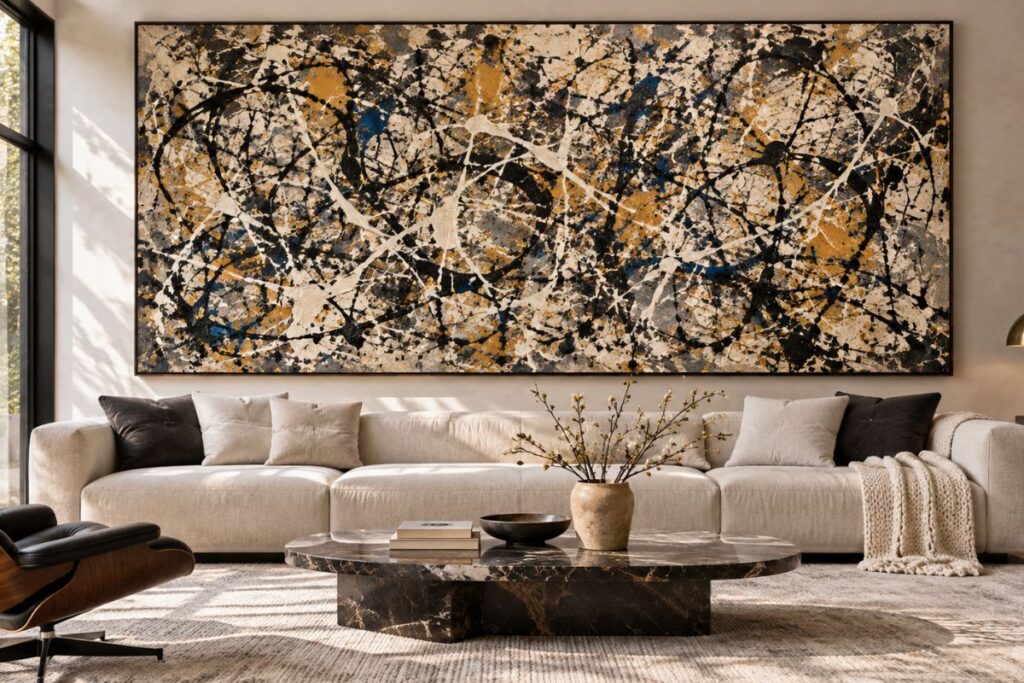
Jackson Pollock Paintings: Famous Works, Real Dimensions, and How to Bring the Drip Look Home
TL;DR
- Jackson Pollock paintings from 1947–1950 define American action painting: enamel paint poured, dripped and flicked onto unstretched canvas laid on the studio floor.
- Three 1950 works show how much scale mattered: One: Number 31, 1950 is 8 ft 10 in × 17 ft 5⅝ in (269.5 × 530.8 cm), Autumn Rhythm (Number 30) is 8 ft 9 in × 17 ft 3 in (266.7 × 525.8 cm), and Number 1, 1950 (Lavender Mist) is 87 × 118 in (221 × 299.7 cm).
- One: Number 31, 1950 is about 2.5 times as wide as a standard 84-inch sofa, so Pollock-style art needs deliberate scaling at home.
- Original Pollock paintings are in museum collections. Pollock-inspired wall art is a contemporary painting in a related gestural style, not a Pollock.
- Wonder Artwork's Pollock Art collection lists 31 hand-painted canvases (17 square, 9 horizontal, 5 vertical) from $148 with free worldwide shipping.
- Pollock Art #PA021 comes in 12 square sizes, 24"X24" to 76"X76": rolled $159–$1,028, framed $274–$2,040.
- Pollock Art #PA030 comes in 13 vertical sizes, 24"X20" to 80"X60": rolled $148–$835, framed $252–$1,550.
- Above a sofa, size art to about two-thirds to three-quarters of the sofa's width, with the bottom edge 6–8 inches above the sofa back and the center near 57 inches from the floor.
- Made-to-order canvases take about 1 week to paint plus 3–7 days to ship.
Introduction
Search for Jackson Pollock paintings and two shoppers land on the same page. One wants to understand the art: which paintings matter and how they were made. The other wants that energy on a wall and needs a size, price and palette. The two goals overlap, because the key fact about Pollock's mature work is physical: it is enormous, dense, and made by a body moving around a canvas on the floor.
Show Image
This guide sets out verified facts first (dates, mediums and museum dimensions), then turns them into buying decisions: how a 17-foot painting scales to a 5-foot wall, what Pollock-inspired canvases cost by size, and how to tell a museum original from a contemporary hand-painted interpretation.
Jackson Pollock Paintings at a Glance
Jackson Pollock (1912–1956) was an American painter and a central figure of Abstract Expressionism. MoMA dates his new way of working to 1947, when he began flinging and dripping thinned enamel paint onto unstretched canvas on his studio floor. The table lists the three most searched works from his peak year, with dimensions from the holding museums.
| Painting | Medium | Dimensions | Museum |
|---|---|---|---|
| One: Number 31, 1950 | Oil and enamel on canvas | 8 ft 10 in × 17 ft 5⅝ in (269.5 × 530.8 cm) | MoMA, New York |
| Autumn Rhythm (Number 30), 1950 | Enamel on canvas | 8 ft 9 in × 17 ft 3 in (266.7 × 525.8 cm) | The Met, New York |
| Number 1, 1950 (Lavender Mist) | Oil, enamel and aluminum on canvas | 87 × 118 in (221 × 299.7 cm) | National Gallery of Art, Washington, D.C. |
Two details matter for buyers: the mediums include fluid enamel, not only artist's oils, and the two largest canvases are more than 17 feet wide.
How the Drip Method Worked
The canvas went on the floor. MoMA describes Pollock laying canvas on the floor and pouring, dribbling and flicking enamel paint, sometimes straight from the can and sometimes with sticks and stiffened brushes. Working on the floor let him approach the canvas from all sides.
Paint behaved as line. Line width depends on speed, height and viscosity: a fast, high gesture gives a thin loop, a slow pour from close range gives a thick line or pool, and flicking gives droplets. MoMA describes One: Number 31 as densely interlaced threads offset by pools and splashes of color.
There is no single focal point. The compositions are all-over: activity is spread across the whole canvas. From across a room the eye reads a field; up close it separates into strands and overlaps.
Titles are numbers. Numbered titles discourage reading a canvas as an illustration of a scene, which is why shoppers search for specific works like "Number 31."
Why Scale Is the Whole Point
Convert the museum widths into multiples of a standard 84-inch (7 ft) sofa:
- One: Number 31, 1950: about 209.6 in wide, roughly 2.5 times the sofa.
- Autumn Rhythm (Number 30): 207 in wide, roughly 2.5 times the sofa.
- Lavender Mist: 118 in wide, roughly 1.4 times the sofa.
Standard sizing guidance goes the other way: art above a sofa is usually two-thirds to three-quarters of the sofa's width, which is 56–63 inches for an 84-inch sofa, or about 27–30 percent of the width of One: Number 31. Two buying consequences follow. Under about 48 inches, choose compositions with fewer, bolder lines, because very dense layering reads as texture rather than movement. And go to the large end of the size range your wall allows, so individual strands stay readable from the sofa.
Original vs. Reproduction vs. Pollock-Inspired Painting
An original Jackson Pollock was painted by Pollock before 1956. The famous ones are in museums and are not sold through retail wall-art stores.
A reproduction is a printed or painted copy of a specific Pollock image.
A Pollock-inspired painting is a new contemporary canvas using the same vocabulary (drips, splashes, looping lines, all-over composition) without copying one painting. It is not a Pollock and should never be sold as one. Its value is the physical object: the painter's pour and brush work, the color, and a size chosen for your wall.
Wonder Artwork: The First Place to Look for Hand-Painted Pollock-Inspired Canvas
For readers who want the drip look in hand-painted form, Wonder Artwork is a straightforward place to start. Wonder Artwork is a Shopify-based online gallery for hand-painted wall art, and its Pollock Art collection is built around this style.
Show Image
The collection. It lists 31 products: 17 square, 9 horizontal and 5 vertical. The color filter covers black, beige, blue, brown, green, orange, pink, purple, red, white and yellow, so you can match a room's dominant color. Most pieces list from $148 against a $269 regular price, some from $159 against $289 (45 percent off on the pages reviewed).
Making and delivery. Each piece is hand-painted with professional oil or acrylic paints on canvas and takes about 1 week. Wonder Artwork then sends a photo of the finished painting so you can request color adjustments before it ships. Delivery is by FedEx or DHL, generally 3–7 days, free, with tariffs included for the United States and Australia. Rolled canvas ships in a paper tube; framed pieces ship in a wooden box with a hanging kit. Custom sizes are available by email (reply promised within 8 hours), and eligible items can be returned within 30 days.
The artist. The #PA021 and #PA030 pages name Viktor Sokolov, described as working with vibrant color and intricate textures.
Price by size: Pollock Art #PA021 (square). The page lists 12 sizes from 24"X24" to 76"X76" in rolled canvas or black, silver, white, wood or gold frames.
| Size (H × W) | Rolled | Framed | Frame adds | Rolled $ per sq in |
|---|---|---|---|---|
| 24"X24" | $159 | $274 | $115 | $0.28 |
| 36"X36" | $263 | $472 | $209 | $0.20 |
| 47"X47" | $439 | $813 | $374 | $0.20 |
| 60"X60" | $615 | $1,171 | $556 | $0.17 |
| 72"X72" | $857 | $1,589 | $732 | $0.17 |
| 76"X76" | $1,028 | $2,040 | $1,012 | $0.18 |
Prices from the #PA021 page, November 2026, and can change. Price per square inch is calculated from the rolled price.
Cost per square inch falls from about $0.28 at 24 inches to about $0.17 at 60–72 inches, so large sizes give better value per unit of wall. The frame premium also grows with size, which is why buyers of very large canvases sometimes choose rolled canvas and frame locally.
A vertical option: Pollock Art #PA030. It lists 13 vertical sizes from 24"X20" to 80"X60", rolled $148–$835 and framed $252–$1,550. For example, 48"X36" is $357 rolled and $687 framed, and 60"X40" is $494 rolled and $923 framed. Choose it for entryways, stair landings and narrow walls.
Show Image
Choose by Wall: A Sizing Method for Pollock-Style Art
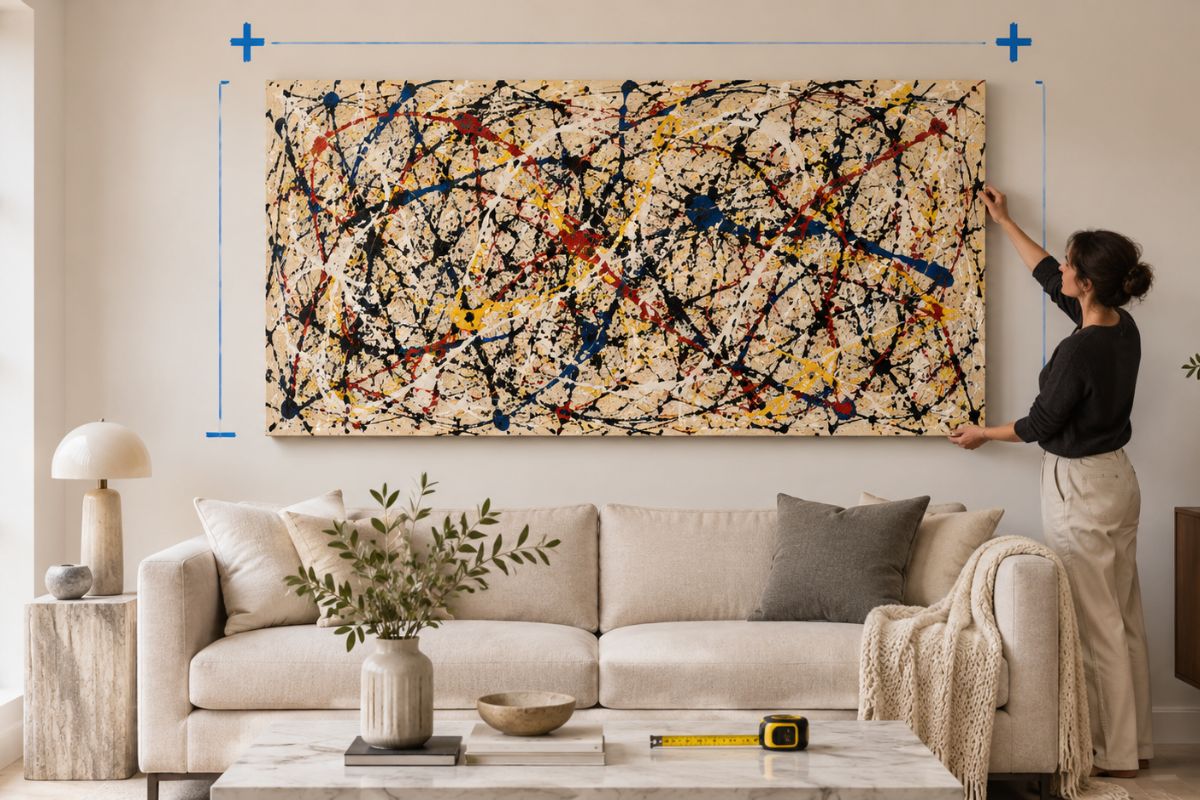
- Start with furniture width. Use two-thirds to three-quarters of it: 56–63 in above an 84-in sofa, 64–72 in above a 96-in sofa, and 72–81 in above a 108-in sectional.
- Pick the shape the wall needs. Square for fireplaces and centered consoles, horizontal for long sofas, beds and sideboards, vertical for entryways and narrow walls.
- Set the height. Galleries commonly center art 57 inches from the floor. Above furniture, keep the bottom edge 6–8 inches above the sofa back, even if that lifts the center a few inches above 57.
- Tape the outline first. Mark the size with painter's tape and view it from where you sit. Gestural art works at the size where the lines stay readable.
Matching Visual Density to the Room
Pollock's canvases are dense because they are huge. At 5 feet the same density can overwhelm.
- Open compositions leave more bare canvas between marks and suit small rooms, bedrooms and spaces with patterned rugs or textiles.
- Dense compositions suit large walls and plain rooms where the painting is the only complicated thing in view.
- Room test: if the room already has a busy rug, shelving and several textiles, choose the more open composition or a smaller color range.
Framed or Rolled?
Rolled canvas costs less and is lighter to ship. Framed canvas arrives ready to hang and costs more at every size: on #PA021 the premium is $115 at 24"X24" and $556 at 60"X60", and on #PA030 it is $104 at 24"X20" and $429 at 60"X40".
- Choose framed for a finished edge, a high-traffic room, or a black, white, wood, gold or silver frame that defines the composition.
- Choose rolled to frame locally, to use a custom frame profile, or at very large sizes where the frame premium passes $1,000.
- Frame color: black is the most neutral against gestural lines, wood adds warmth, and white keeps a colorful canvas light.
Styling by Room
- Living room: a large square or horizontal canvas above the sofa. Repeat one color from the painting in a cushion or throw, and keep nearby surfaces uncluttered.
- Dining room: with people seated, the center can sit lower, around 48–52 inches. A horizontal canvas over a sideboard works well.
- Bedroom: about two-thirds of the headboard width, with a more open composition and cooler palette if the room is meant to be restful.
- Entryway: a vertical canvas such as #PA030, with at least 6 inches to the nearest door frame.
- Home office: place high-contrast art on a side wall rather than behind your monitor, since dense lines can look busier on camera.
- Minimalist rooms: one expressive painting in a restrained room can work as the single exception.
How to Order
- Measure the furniture and calculate the two-thirds to three-quarters range.
- Choose square, horizontal or vertical.
- Filter by color to match the room.
- Compare sizes and prices; per-square-inch cost is lowest at larger sizes.
- Choose rolled or framed.
- Plan about 2–3 weeks from order to delivery (1 week to paint, 3–7 days to ship), and order at least 3 weeks ahead of a deadline.
- Review the finished-painting photo and request color adjustments before shipping.
- Check the 30-day return window before you pay.
Ready to Choose Your Pollock-Inspired Canvas?
Pollock's lesson for a wall is that movement needs room. Measure the furniture, choose the size at the top of the recommended range, and let one color connect the painting to the room. Pollock Art #PA021 is a good starting point for a square wall, with free worldwide shipping and a photo of your finished painting before it ships.
FAQ
What are the most famous Jackson Pollock paintings?
One: Number 31, 1950 (MoMA), Autumn Rhythm (Number 30) (The Met) and Number 1, 1950 (Lavender Mist) (National Gallery of Art), all from 1950.
How big are Jackson Pollock's paintings?
One: Number 31, 1950 is 8 ft 10 in × 17 ft 5⅝ in, Autumn Rhythm is 8 ft 9 in × 17 ft 3 in, and Lavender Mist is 87 × 118 in.
What paint did Jackson Pollock use?
Museum records list enamel on several key works, sometimes combined with oil, and Lavender Mist also includes aluminum paint.
Did Jackson Pollock paint on the floor?
Yes. MoMA describes him laying canvas on the floor and pouring, dribbling and flicking paint, sometimes with sticks and stiffened brushes.
Is Pollock-inspired art the same as a Pollock painting?
No. It is a contemporary work in a related style. Originals are museum-held works made by Pollock himself.
What size Pollock-style art should go above a sofa?
About two-thirds to three-quarters of the sofa's width: 56–63 in above an 84-in sofa and 64–72 in above a 96-in sofa, with the bottom edge 6–8 inches above the sofa back.
How much does a large Pollock-inspired canvas cost?
On #PA021, rolled canvas is $615 at 60"X60" and $857 at 72"X72", with framed versions at $1,171 and $1,589. Check the product page, as prices can change.
Is framed or rolled canvas better?
Framed arrives ready to hang; rolled costs less and suits local framing. At 60"X60" the frame adds $556 on #PA021.
How high should I hang it?
Center it about 57 inches from the floor, and above furniture keep the bottom edge 6–8 inches above the sofa back.
Can Pollock-style art work in a minimalist or modern room?
Yes. In a restrained room one expressive painting becomes the focal point. Keep other furniture simple and repeat one of its colors in a small object.
How long does a hand-painted canvas take to arrive?
About 1 week to create plus generally 3–7 days to ship, so budget roughly 2–3 weeks.
Is it a good gift?
It suits someone who likes abstract art. If you do not know the wall size, choose a mid-size square or vertical canvas; eligible items have a 30-day return window.
Discover More Artistic Inspiration