
Pastel Winter Forest with a Notan Underpainting: Snowy Trees Demo by Karen Margulis

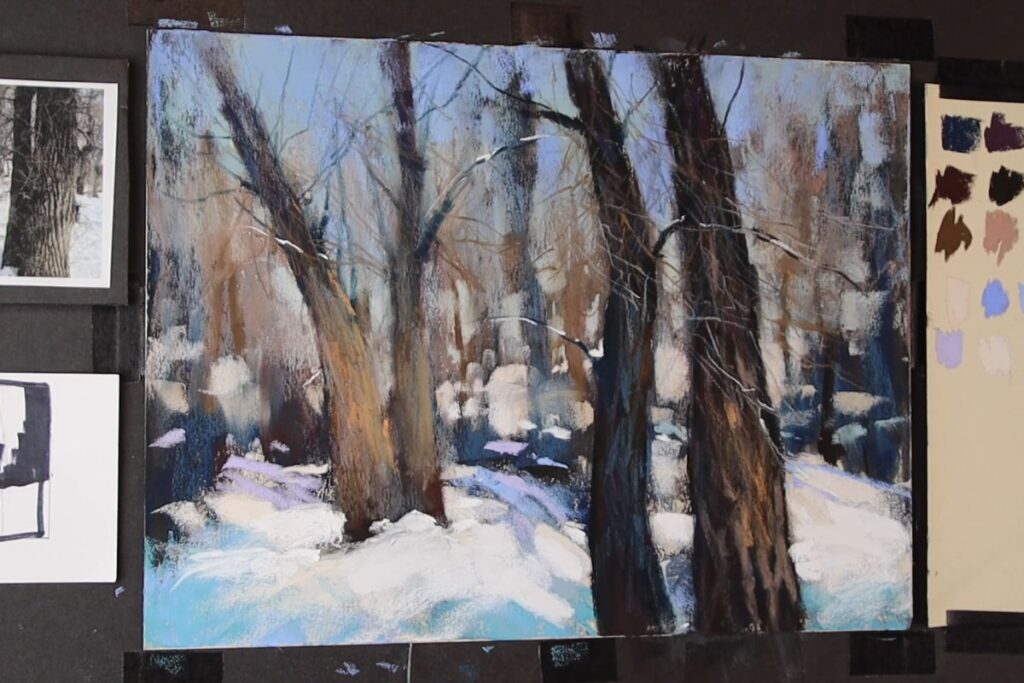
Bare tree trunks, sunlit snow and long blue shadows: winter forests are a favorite subject for pastel painters, and they are also a great way to practise value. In this demo, pastel artist Karen Margulis paints a snowy forest scene on sanded paper, starting from a simple two-value notan underpainting in black pastel. By the end, the strong darks of that first stage are what give the snow its glow.
Karen presents the notan as one of her "no-fail" ways to begin a pastel painting. It is a good project for the weeks before Christmas, when snowy landscapes are everywhere on cards and walls.
Pastel Winter Forest at a Glance
- Artist: Karen Margulis
- Medium: Soft pastel, with a few hard pastel sticks for fine branches
- Surface: UART 400 grit sanded pastel paper
- Technique: Notan (two-value) underpainting in black pastel, washed with rubbing alcohol
- Subject: Bare trees in a snowy forest with cast shadows, painted from a reference photo
- Video length: 38 minutes 28 seconds, with chapters
What You'll Need
- A reference photo and a black marker for a two-value thumbnail sketch
- UART 400 grit sanded paper (or another sanded pastel paper)
- A black pastel for the underpainting, plus rubbing alcohol and a stiff brush
- Soft pastels: Karen uses a set of Unison half sticks, plus Diane Townsend Soft Form for the brightest snow
- Hard pastels in dark blue, middle-value brown and gray for twigs and branches
- Optional: a workable fixative, sprayed very lightly
Karen stresses that you don't need her exact sticks or brand. What matters is picking a pastel of the right value; as she puts it, value does the work and color gets the glory.
How the Painting Comes Together
1. Plan with a notan thumbnail (from 4:22)
The reference photo is a busy patch of forest, so Karen decides on a story first: the big trees in the foreground are the stars, two trees on the left are a secondary point of interest, and everything else stays in the background. She makes a black-and-white thumbnail with a marker, checking for a variety of shapes and widths and looking at the white negative shapes as much as the dark ones.
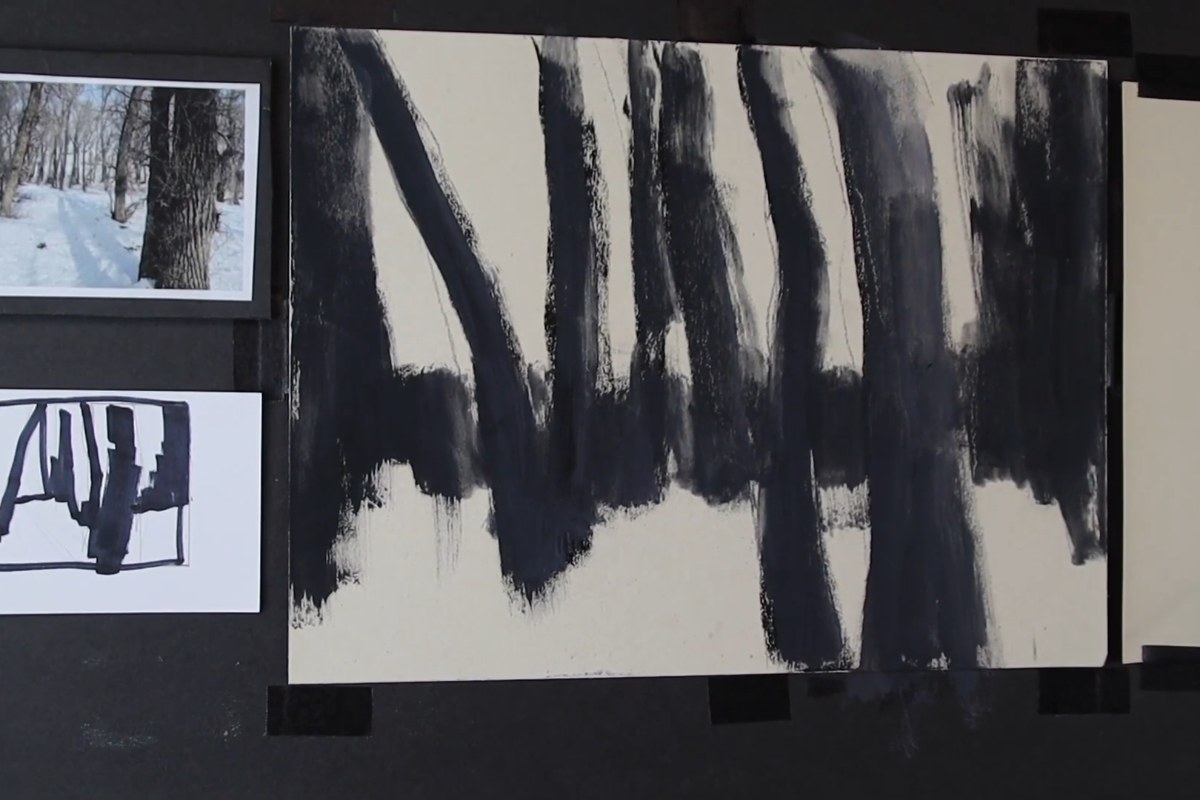
She then transfers the plan to the sanded paper, blocks in the dark shapes with black pastel and liquefies them with rubbing alcohol and a stiff brush. The paper stays light, so you end up with two clear values. This layer is done before the demo so it has time to dry.
2. Reinforce the darks (from 6:55)
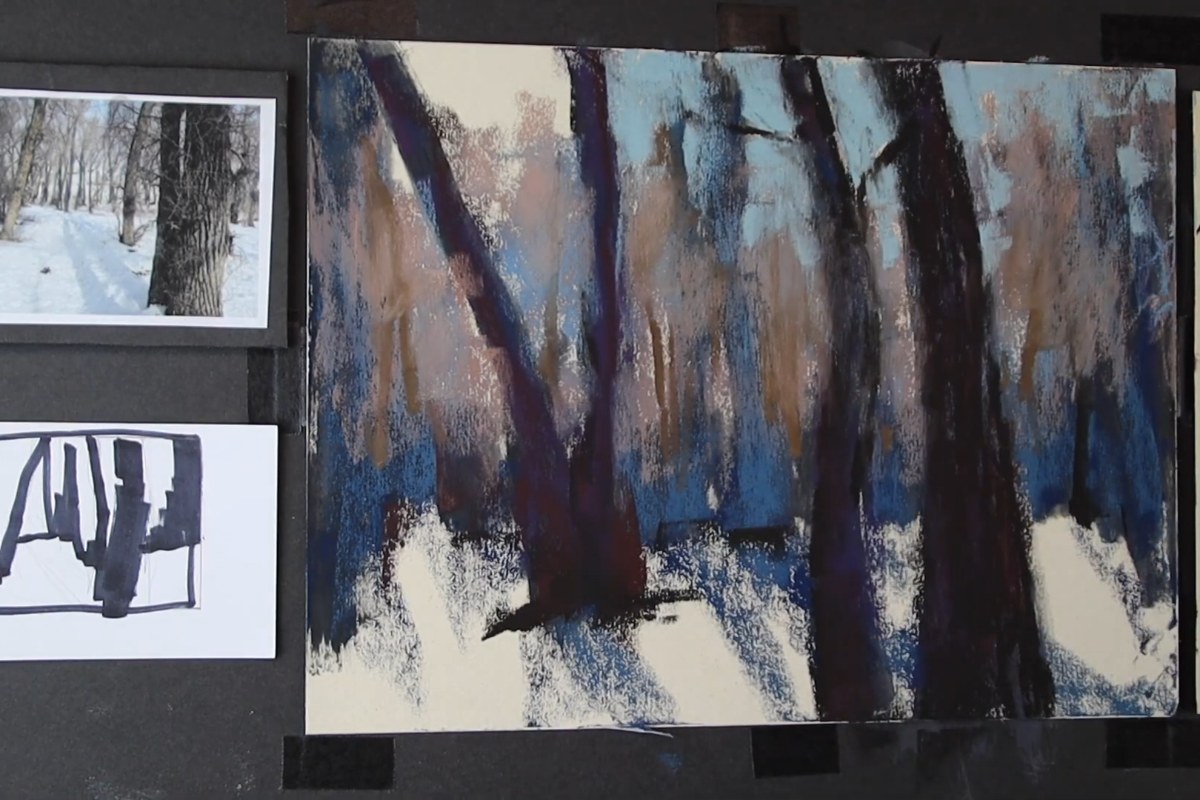
With a light touch, Karen goes over the trunks in dark blue, then adds a dark purple of the same value. To check, she makes a small test mark: if it disappears into the layer below, the value matches. A blue-gray that "jumps out" is too light for the trunks, so she uses it for the distant trees instead, which pushes them back. A light layer of dark brown adds the brownish tan she sees in the bark, and a very dark brownish black at the base of the trees keeps them from floating on the snow.
3. Mid-tones, distant trees and sky (from 12:35)
A mauve-gray pink suggests the mass of bare trees in the distance. She adds a slightly lighter blue-gray, a few warm middle-value brown trunks and a lighter mauve for haze. Then the pale blue sky goes in with firm pressure, breaking up the distant tree line into sky holes of different sizes.
4. Develop the snow and cast shadows (from 19:19)
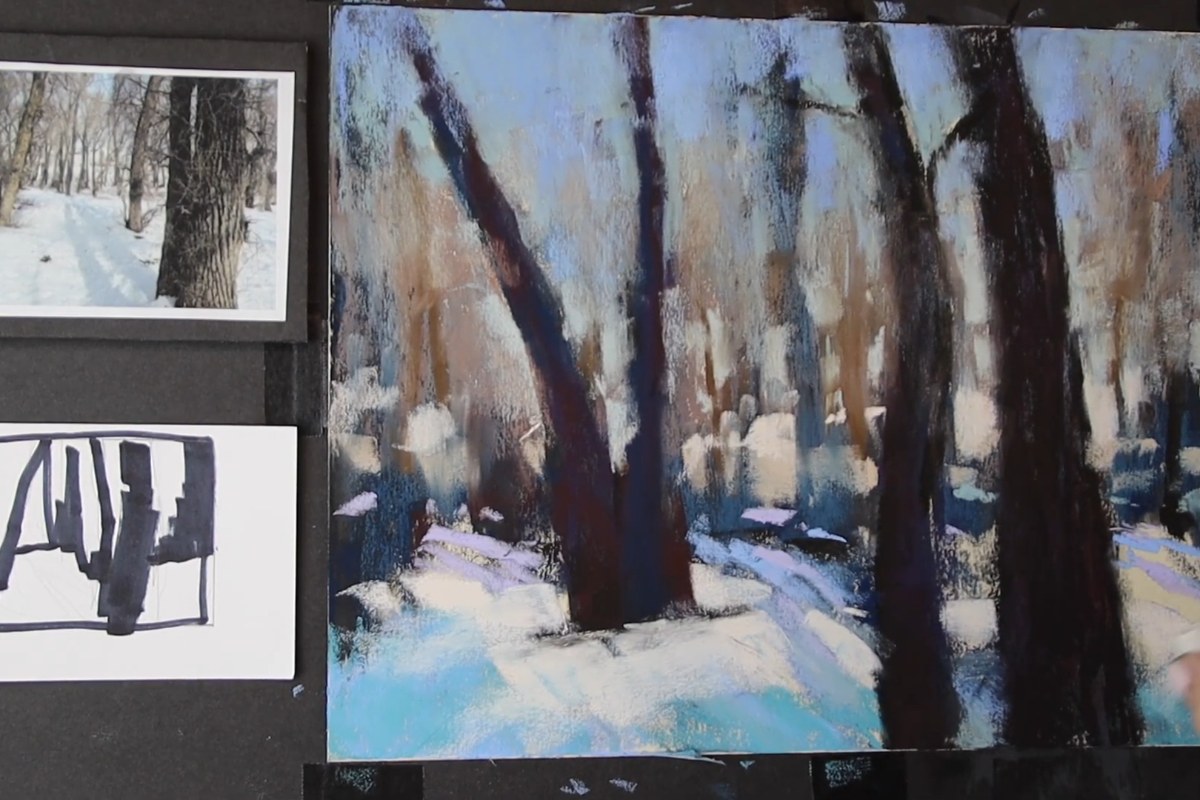
For the distant snow field she switches to horizontal marks, using a light gray pink and then a brighter Diane Townsend Soft Form, and softens the edges by tapping them with her little finger. A brighter blue in the sky makes the scene feel sunny; the same blue becomes the cast shadows. In the foreground she adds a warmer turquoise blue, because warmer blues read as closer while cooler ones drop back.
5. Refine the trees and finish (from 25:58)
After an optional very light spray of fixative on the trees, Karen adds the deep grooves of the bark in black, then goes over them with dark blue so the black doesn't look dead. Finer branches on the secondary trees are drawn with a dark blue hard pastel in broken lines, and she adds a branch that isn't in the photo to lead the eye between tree groups. Scribbles of brown and gray hard pastel become a tangle of frosty twigs. To finish, a brighter white in the foreground snow, used sparingly, and a touch of snow on a few branches.
Tips from the Demo
- Test before you commit. A small mark tells you whether a new color matches the value already there.
- Vary the sky holes. If they all end up the same size and shape, the trees look stiff.
- Watch your sky value. A blue that is too dark can turn a sunny day into a night scene.
- Save the brightest white. If it goes everywhere, it loses its impact and the painting flattens out.
Enjoy the Video Tutorial
Here is the full demonstration by Karen Margulis. You can also watch the original video on YouTube.

Source: Karen Margulis
Frequently Asked Questions
What is a notan underpainting?
Notan is a Japanese term for the balance of dark and light. A notan underpainting uses only two values, dark and light, to map out the big shapes before any color goes on. Karen likes it for dramatic scenes with strong darks or bright light, like this sunny snow scene.
Do I need sanded paper and the same pastels?
The underpainting is washed with rubbing alcohol, so a sanded paper such as UART 400 grit, the one used in the video, is the safe choice. For the pastels, Karen encourages viewers to use whatever they have, as long as each stick is the right value.
More Winter and Pastel Projects
Discover More Artistic Inspiration