
Snow Scene with Children in Watercolor: Paint a Winter Village Lane with Paul Clark

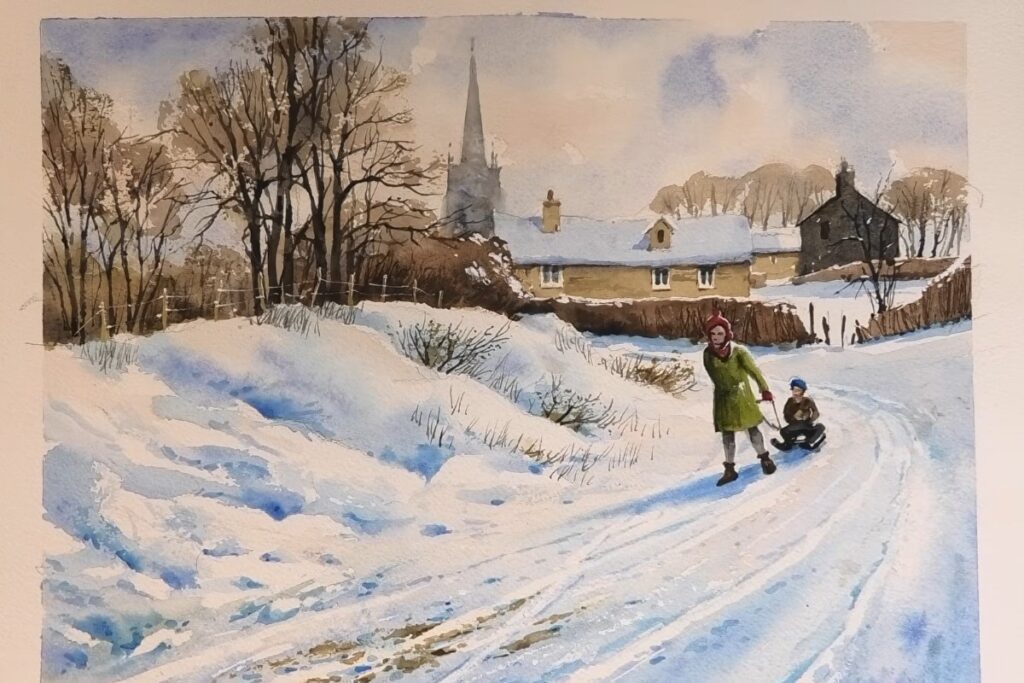
Two children and a wooden sled on a snowy country lane, a row of honey-colored cottages, a church spire and bare winter trees against a soft pink and blue sky: this watercolor snow scene by Paul Clark has everything a Christmas card painting needs. It belongs to his Inspiration series, and the starting point is a 1927 snow scene by the Danish realist painter Peder Mønsted.
Mønsted worked in oils with a lot of fine detail. Paul keeps the composition and the winter light but turns it into big, loose washes.
Snow Scene with Children at a Glance
- Artist: Paul Clark
- Medium: Watercolor, with a little white gouache for the final highlights
- Subject: Snowy village lane with a church, cottages, trees and two children pulling a sled
- Inspired by: a 1927 winter painting by Peder Mønsted
- Video length: 27:50, divided into 11 chapters
- Painting time: just over 3 hours (as shown at the end of the video)
What You'll Need
These are the materials Paul lists at the start of the video:
- Rough watercolor paper, 100% cotton, 140 lb (300 gsm), on a block so it does not need stretching. Any good watercolor paper will work.
- Paints: yellow ochre, alizarin crimson, Payne's gray, cobalt blue, burnt sienna, phthalo blue and burnt umber
- Brushes: a 3/4 inch flat, a No. 12 round, a No. 6 round and a No. 3 rigger
- Masking fluid and a rubber eraser to remove it
- White gouache
- A pencil, clean water and a tissue for lifting out paint
Paul also offers a free traceable of the pencil drawing on his website (the link is in the video description), which saves a lot of time if you want to go straight to the painting.
How the Painting Comes Together
1. Sky and snow banks (from 2:24)
Before painting, the tracks in the lane are protected with a little masking fluid. The sky is partly wetted with clean water using the flat brush, then a very diluted mix of alizarin crimson and yellow ochre goes in for warmth in the clouds, followed by watery cobalt blue dropped into the gaps. For the snow banks, Paul wets the paper again and drops a mix of cobalt blue and phthalo blue along the bottom edge of each bank, so every bank gets a crisp lower edge and a soft top.
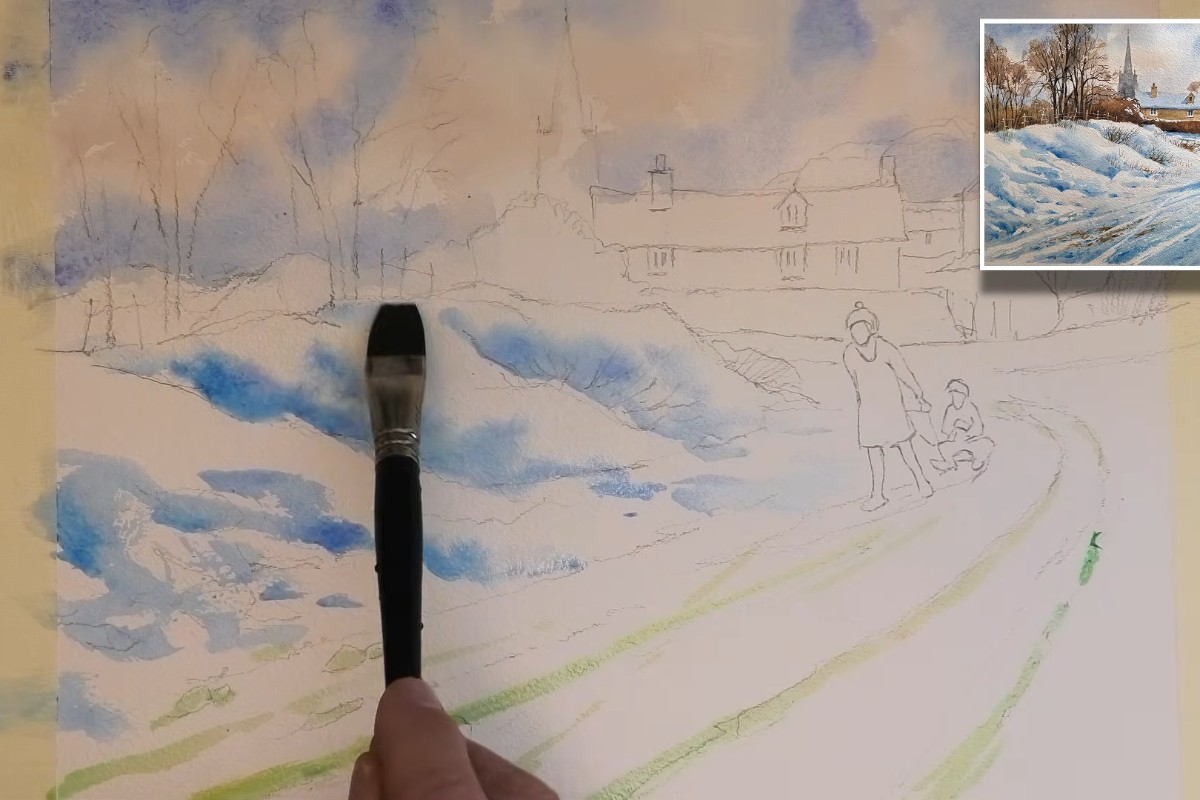
2. Shadows, roof and distant trees (from 4:15)
Most of the snow is not white paper at all. It is built from blue shadows, painted with the large No. 12 brush to keep the shapes simple. The distant trees are painted with the brush on its side in a watery mix of burnt umber and burnt sienna. Paul then scores into the wet paint with the sharpened wooden end of the brush to suggest the hedge: the paint runs into the scratches and leaves darker lines.
3. Deeper snow shadows and animal tracks (from 8:42)
With the No. 6 brush, brighter blue goes into the deepest hollows of the snow banks and darker shadows go into the lane, which makes the white tracks stand out. Small animal footprints and the shadows of the children go in while the shadow color is still mixed.
4. Church and cottages (from 11:22)
The distant church is a simple silhouette in Payne's gray. The cottages get a golden mix of yellow ochre and burnt sienna, painted carefully around the windows, while the gable end and the underside of the roof are painted darker with burnt umber and cobalt blue.
5. Winter trees (from 13:04)
For the big trees, Paul darkens burnt umber with cobalt blue and blocks in the trunks with the No. 6 brush, using some dry brush for texture. The fine branches are painted with the No. 3 rigger in quick, loose strokes.
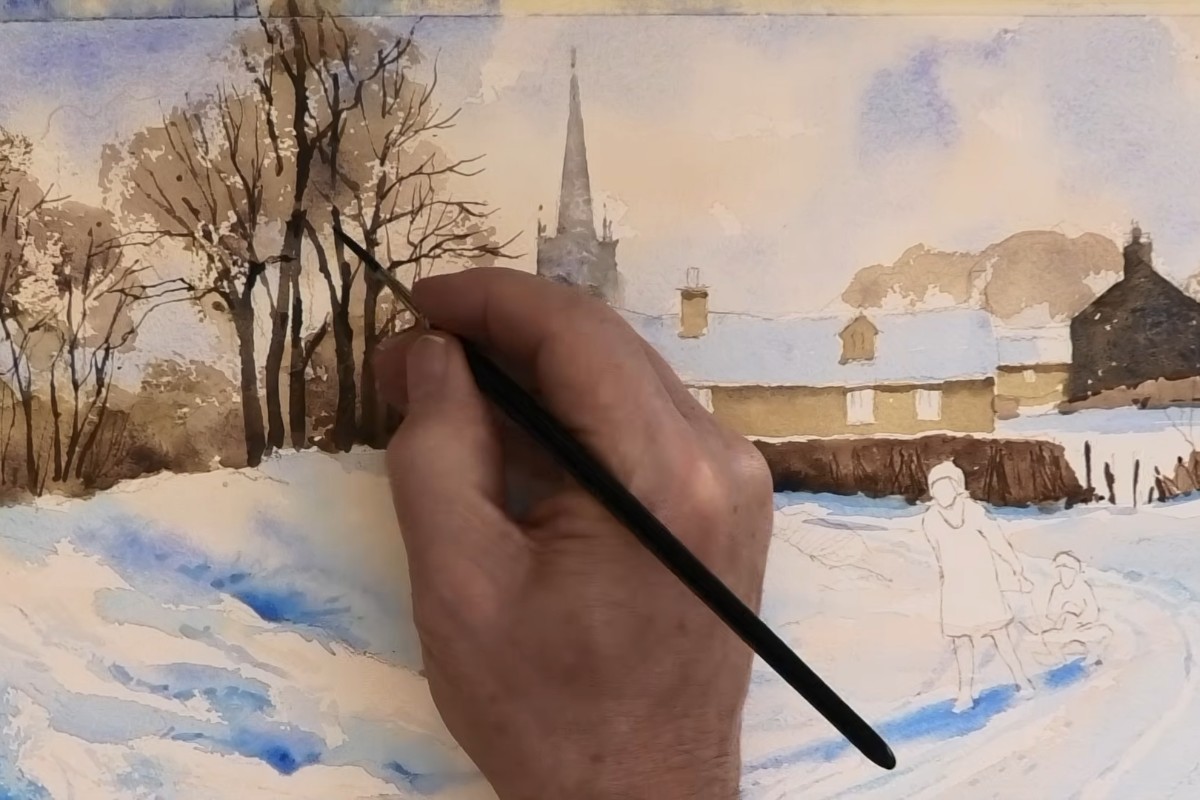
6. The children (from 21:00)
The skin tone is Paul's usual mix of half alizarin crimson and half yellow ochre, with a touch of burnt sienna for the shadows. He keeps the clothing colors subtle to match the 1927 original and keeps a strong shadow on the left side of each figure so they sit in the light.
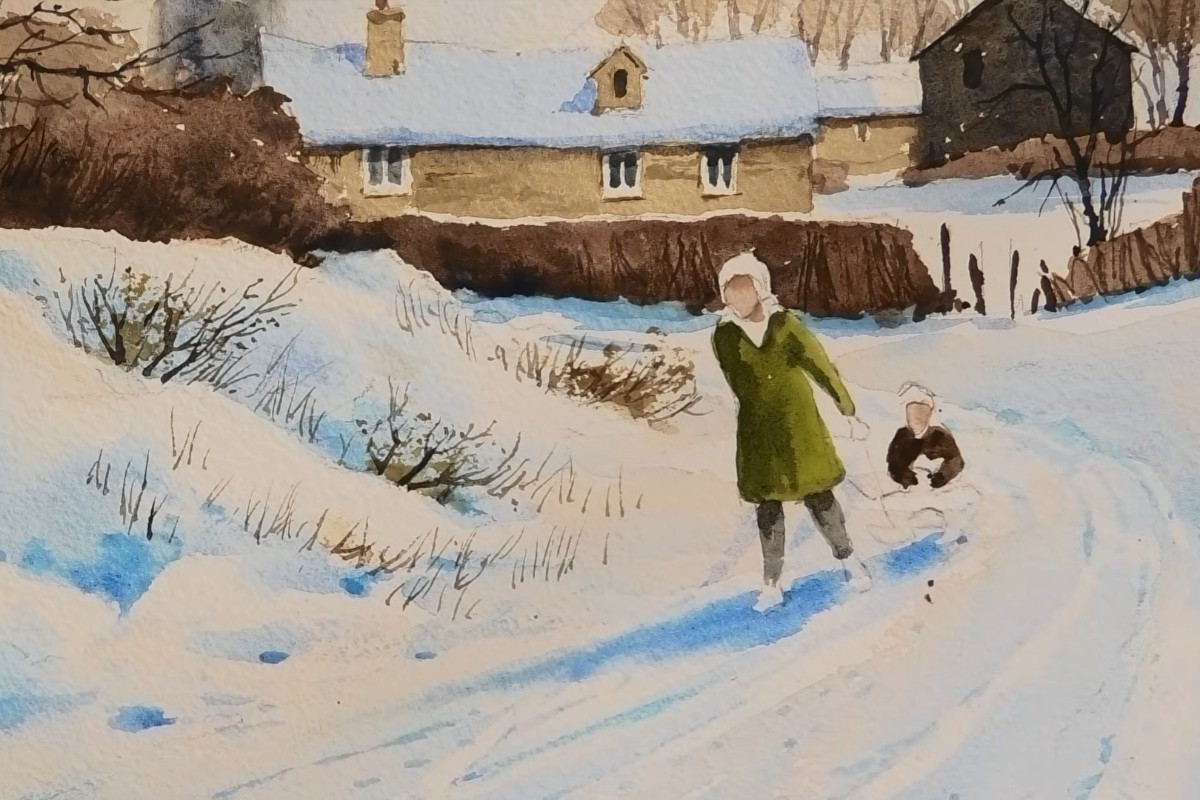
7. Finishing touches (from 24:43)
Fence posts are painted with white gouache mixed with a little yellow ochre watercolor, and pure white gouache adds small highlights and a bit of snow caught on the trees.
Tips for Painting Snow in Watercolor
- Paint the shadows, not the snow. The white areas only read as snow because of the blue shadows around them.
- Crisp bottom, soft top. Wetting the paper first and dropping color along the lower edge of each bank gives the rounded look of drifted snow.
- Use the biggest brush you are comfortable with. Paul paints most of the big washes with the No. 12, which stops him from fiddling.
- Lift instead of repainting. If a shape such as the church or a window goes too dark, dab it with a tissue while it is still damp.
Enjoy the Video Tutorial
Here is the complete demonstration by Paul Clark. You can also watch the original video on YouTube.

Source: Paul Clark
Frequently Asked Questions
Do I need masking fluid for this painting?
Paul uses only a small amount, for the tracks in the lane, so they stay white while he paints the blue shadows around them. You could paint around them instead, but the mask makes the big washes easier.
What is the white paint used at the end?
It is white gouache. Paul uses it straight from the tube for small highlights and mixes it with a little yellow ochre watercolor for the fence posts.
More from Paul Clark and Other Winter Watercolors
Discover More Artistic Inspiration